
Insights / Sound design
Sound design and audio post-production for video: what's the difference and what are you paying for
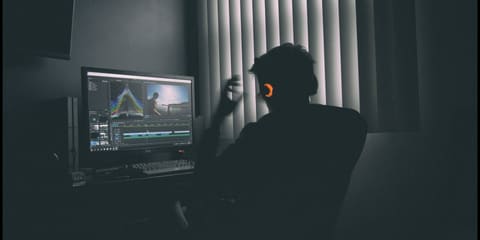
In video work, sound design and audio post-production are often used as synonyms, and sometimes they are: "sound design" sounds better and draws more interest from people outside the trade, "audio post-production" is the technical name. When the two terms mean different things, the difference is between the creative side of a video's sound and the technical side. Understanding it helps when writing a brief and reading a quote.
Here "sound design" has the meaning it has in video. It should not be confused with the other craft that goes by the same name: creating sounds from scratch or from samples, through synthesis and processing, for instruments, video games or sound libraries.
Sound design: the creative side
Doing sound design means scoring a video with sound, creatively: building its sound world with effects, ambiences, foley and music, under an artistic direction. The video does more than show images, it can be heard: the material that bends, the room where someone is speaking, the move from one scene to the next.
The typical elements:
- sound effects (SFX): objects, machines, impacts, interfaces;
- ambiences: the background sound of a place, which gives space and continuity to the shots;
- foley: sounds recorded in sync with the picture, such as footsteps, clothes, hands, objects being handled;
- transitions: the sounds that go with cuts, titles and graphics;
- textures and abstract sounds, when the video tells an idea more than a scene;
- the music choice, when it is part of the artistic direction.
Sound design is not only for video: it is also done for installations, apps and radio programmes.
Audio post-production: the technical side
Audio post-production works on material that already exists: interviews, production sound, voice-over, music, even sound design made by someone else. It puts it in order, cleans it up and brings it to a finished mix, ready for its destination.
It usually includes:
- dialogue editing: choosing the best takes, clean cuts, continuity from one shot to the next;
- cleanup: reducing noise, hum and reverb;
- ADR, re-recording in the studio the lines that were badly recorded on set, when needed;
- music editing to the cut: edits, endings and restarts lined up with scene changes;
- mix: the balance between voice, music and effects;
- loudness and delivery: the right level for each platform, explained in the guide on what LUFS to deliver.
Where they overlap
The line is not sharp. The mix also has a creative side and a matter of taste: deciding when the music makes room for a sound, or how much of an ambience to let through, is a storytelling choice as well as a technical one. The practical rule: when the artistic choices about sound are made by the person working on the audio, you are also buying sound design; when the job is to fix and mix material already chosen by others, it is post-production.
In video projects it pays not to stop at music and speech. Transition effects, foley and ambiences make the video live beyond the picture, even in an interview: in Winemakers of Friuli the family's voices are the thread, and underneath there is a layer of sound design. At the opposite end, The evolution of the species is all abstract sound design, built as a crescendo.
Who does what
Several people often work on the audio of a video, and sometimes one person covers several roles:
- the production sound mixer records the voices on set;
- the voice-over artist records the narration;
- the composer writes the original music, when library music is not used;
- the sound designer builds effects, ambiences and foley;
- whoever does audio post-production edits, cleans up and mixes everything, and delivers.
The most common misunderstanding
When an agency asks for "the sound design", it often means several things: the music choice, the voice mix, or all of the video's audio. To avoid quotes that cannot be compared, the brief should describe what is needed:
- which audio material already exists (production sound, voice, music) and which needs to be created;
- whether effects, ambiences and foley are needed, or only the voice and music mix;
- where the video will be released (social, YouTube, TV, streaming platforms, cinema);
- which files are needed at the end;
- a reference piece, if there is one.
For the material to prepare for whoever works on the audio, see the guide on what to deliver to your sound designer.
What you receive at the end
The basic delivery is the master, the finished mix, in the versions for the planned destinations: web, TV, platforms. On request you can also get:
- the stems, the mix split into dialogue, music and effects: summed together they give back the full mix. Netflix, for example, requires them for every original-language mix;
- the version without voice (M&E, music and effects), useful for adapting the video into other languages or replacing the voice-over;
- alternative versions, for example without music or with different cuts.
It is worth asking for them before work starts, even if they are not needed right away: preparing stems during the job is simple, rebuilding them months later much less so.
Every project is different: write to me with the video, or the brief, and we will work out together what it needs.
Sources
Treccani, Lessico del XXI secolo, entry "Sound design" (treccani.it) · Accademia di Belle Arti di Venezia, "Sound design. Ambiguità e necessità storica di un termine alla moda" (accademiavenezia.it) · Netflix Partner Help Center, "Netflix Sound Mix Specifications & Best Practices" and "M&E Creation & Delivery Guidelines" (partnerhelp.netflixstudios.com) · EBU, Recommendation R 128 on loudness (tech.ebu.ch).