
Insights / Mix and loudness
What LUFS should a video be delivered at? Instagram, YouTube, TV and cinema compared
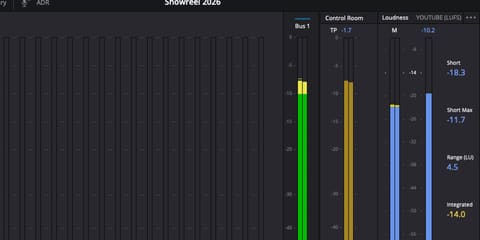
LUFS (Loudness Units relative to Full Scale) measures how loud a programme sounds as a whole, not how high its peak is. It is the number platforms and broadcasters use to decide how much to turn a video up or down, and so it is the first thing to know before closing the mix. The values below are those in use in September 2026.
The table
| Destination | Integrated loudness | True peak | Who says so |
|---|---|---|---|
| YouTube | -14 LUFS | -1 dBTP | YouTube |
| Instagram, Facebook, TikTok | -14 LUFS (estimate) | -1 dBTP | no official value |
| Website, trade show, presentation | -16 / -14 LUFS | -1 dBTP | common practice |
| TV and TV commercials in Europe | -23 LUFS (±0.5 LU) | -1 dBTP | EBU R128 |
| US TV | -24 LKFS | -2 dBTP | ATSC A/85 |
| Netflix | -27 LKFS (±2) on dialogue | -2 dBTP | Netflix |
| Podcast (Apple) | -16 LUFS | -1 dBTP | Apple |
| Cinema | no LUFS target: calibrated theatre | Dolby / SMPTE |
LUFS and LKFS are the same unit with two names (European and American). dBTP is true peak, the real peak of the signal after digital-to-analogue conversion: it is measured with a true peak meter, not with the regular peak meter.
YouTube: -14 LUFS, and it only turns down
YouTube normalises to about -14 LUFS. A louder video is turned down; a quieter video is not turned up. So a mix at -20 LUFS sounds quieter than everything else on YouTube, and a mix at -9 LUFS is brought back to -14 with the only result of having lost dynamics. The useful level is -14 with peaks at -1 dBTP. The applied value can be read in the player, right click > "Stats for nerds", under "Volume / Normalized".
Instagram, Facebook, TikTok: no official number
Meta and TikTok do not publish a target. Meta re-encodes audio in xHE-AAC with adaptive volume management, which changes with the playback context; measurements by people who work with it cluster around -14 LUFS. TikTok does not normalise in the feed as of July 2026: a louder file really does sound louder, with the compression that comes with it.
The defensible value for a reel or a social ad is -14 LUFS, peaks at -1 dBTP. If a brief asks for "louder", it can go up to -12, knowing that dynamics are being given up, not that a specification is being met. Keep in mind that the platform re-compresses the file anyway (low-bitrate AAC): peaks at -1 dBTP are there so that it does not distort in that step.
Website, trade shows, presentations
There is no normalisation: the file sounds exactly as delivered. -16 LUFS is the level that works both on headphones and from a laptop; -14 if the video sits next to social content. On a trade show screen with its own speakers the volume is set by the system, and a mix with the voice up front counts more than the number.
TV and TV commercials: EBU R128
In Europe, Italy included, broadcasters apply the EBU R128 recommendation: integrated loudness -23 LUFS, tolerance ±0.5 LU (±1 LU for live), maximum true peak -1 dBTP. For commercials and short content the short-term loudness limit of -18 LUFS also applies, so an ad cannot sound louder than the programme it sits in. A file outside tolerance is rejected or renormalised by playout, and in the second case nobody controls the result.
Each broadcaster has its own delivery specifications (format, tracks, audio layout): better to ask for them before mixing, not after.
Netflix and streaming platforms
Netflix measures loudness on dialogue (dialog-gated) and asks for -27 LKFS ±2, true peak -2 dBTP. Amazon Prime Video asks for -24 LKFS ±2 on the whole programme, with the same true peak; Apple TV+ and Disney+ each have their own delivery document. These levels are much lower than social ones because the measurement is different (speech only) and because listening happens in a room, not on headphones on the underground.
Cinema: no LUFS, the theatre is calibrated
There is no normalisation in the theatre: the projector plays the file at the standard calibration level (85 dB SPL at -20 dBFS per channel, the Dolby "fader at 7"). So the mix is judged in a theatre calibrated the same way and the level is set by the mix itself; a film mixed on headphones at -14 LUFS is deafening in a theatre. Trailers have a separate ceiling, Leq(m) 85 dB (TASA), measured with a weighting curve different from LUFS. In practice, a cinema mix is made or checked in a calibrated theatre, and LUFS only comes into play when a streaming or TV version of the same film is prepared.
One mix for every destination?
No: between -14 and -23 LUFS there are 9 LU of difference, almost twice the perceived loudness. The method is:
- Mix once at the level of the main destination, usually the most demanding one (TV or streaming).
- Derive the other versions from that mix by changing only level and limiter, checking the true peak on each version.
- Deliver each file with a name that says what it is for (
_TV_R128,_web_-14), so nobody uploads the wrong one.
A mix born at -14 LUFS is not brought to -23 simply by turning it down: the compression already printed stays. The opposite does work.
In short. YouTube and social -14 LUFS / -1 dBTP · web and trade shows -16 / -14 · European TV -23 LUFS / -1 dBTP with short-term max -18 for ads · Netflix -27 LKFS on dialogue / -2 dBTP · cinema calibrated theatre, trailers Leq(m) 85.
What is needed for the check
The final file and the list of destinations are enough. Measuring integrated loudness, true peak and short-term takes a few minutes and returns a report for each version. If the video has to go to several places, write to me before the final mix: the starting level gets decided and the versions all come out together.
Sources
EBU R 128 v5.0, "Loudness normalisation and permitted maximum level of audio signals" and supplement s2 on short-form content (tech.ebu.ch) · ATSC A/85, "Techniques for Establishing and Maintaining Audio Loudness for Digital Television" · Netflix Partner Help Center, "Sound Mix Specifications and Best Practices" · Amazon Video Central, audio specifications · Apple Podcasts for Creators, "Audio requirements" · Forasoft, "LUFS targets per platform in 2026" (forasoft.com), for Meta xHE-AAC and TikTok without normalisation · TASA, Trailer Audio Standards (Leq(m) 85) · Dolby, theatre calibration at 85 dB SPL.