
Insights / Sound design
What is foley and when does a commercial or corporate video need it
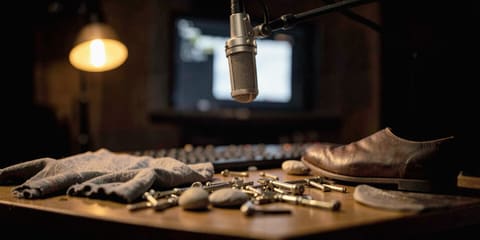
Foley is the set of on-screen sounds recreated in sync with the picture: footsteps, clothing movement, hands touching an object, a cup set down on a table. In videos shot without production sound, or with unusable production sound, these sounds are missing entirely, and a video without them sounds empty even when the music and the voice are perfect.
The short answer. Foley is the set of on-screen sounds recreated in sync with the picture: footsteps, clothing, objects. It is needed when production sound is missing or unusable, and more in videos with people, gestures and objects in close-up. In commercials, enlarged sound effects prevail, with some targeted foley.
The name comes from Jack Foley, a technician at Universal Studios who, with the arrival of sound in the late 1920s, recorded effects live while the film played on screen. The principle has not changed: watch the picture and recreate the sound in sync.
Foley, libraries and production sound
These are three different sources of sound, and a video usually uses more than one:
- production sound: sounds recorded on set together with the picture. They are the most natural, but often dirty, covered by dialogue or by the noise of the location, or thin, lacking detail because the microphone is pointed elsewhere;
- library effects: sounds already recorded, from archives such as Soundly or Freesound, chosen and placed on the video. They are quick and cover almost everything, but their timbres vary a lot;
- foley: sounds recorded or built specifically for that video, object by object, in time with the action, rich in detail and texture, chosen for the purpose.
The boundary is not sharp. A foley sound can come from a studio recording, from a personal archive built up over the years, from improvised objects or from a combination of several sources. Every approach is valid if the result serves the product: the viewer cares that the sound is right, not where it comes from.
When it is needed
Foley is useful in almost every kind of video, and more so where sound tells the scene: documentaries, fiction, but also brand films, stories with people, gestures and objects.
In commercials the picture changes. A product's sound is almost always a sound effect rather than foley: it takes the timbre of the natural sound as its reference, but enlarged, sharper and more present than it would be in reality, because a commercial calls for that. A car door, a drink being poured, a close-up gesture: you start from the real thing and take it "larger than life". That is why the work on commercials is often a mix of library effects, sounds built from scratch and some targeted foley.
In corporate videos foley matters less when the video is only interviews and stock footage, and more when there are people at work, machinery, handled products or detail shots. These are the sounds that make a company feel like a real place.
When it is not needed
A TV news item can do without it. In every other case the point is different: well-made foley is invisible: it sits in the right place, so it feels natural for it to be there, it does not distract, it completes. Nobody asks for sounds that "seem real" to be removed; clients have even asked to keep only the "real sounds", unaware that all of it had been recreated. That is exactly why the work is noticed only when it is missing. It depends on who does it: where each sound is placed, with which perspective (close to or far from the camera), with which reverb and timbre, so that it blends into the rest of the mix. The sensitivity of the foley artist and the sound editor is essential.
How long it takes
Foley is meticulous work. Time grows with the number of actions to cover, with close-ups, with the precision of sync required and, above all, with the level of originality: an exclusive job, recorded from scratch, takes much more time than one that makes use of archives. That is why it is assessed and quoted case by case.
What to say in the brief
Agencies rarely ask for foley by name, and there is no need: it is up to whoever works on the audio to judge whether it is needed, place it where it helps and include it in the quote. A few pieces of information in the brief do help:
- whether the video was shot without audio or with production sound that is hard to use;
- whether there are product close-ups, gestures or actions that need to "sound";
- whether the style should be realistic or exaggerated;
- one or more reference videos: it is the quickest way to understand the result you are aiming for.
For the difference between the creative and the technical side of audio, see the guide on sound design and audio post-production.
Every project is different: write to me with the video, or the brief, and we will work out what it needs together.
Sources
- Wikipedia, entry "Foley (sound design)" (en.wikipedia.org)
- Cinemontage, "Foley: They Make the Noises for the Talkies" (cinemontage.org)
- TechRadar, "Foley: the art of movie sound effects" (techradar.com)
- SoundWorks Collection, interviews with sound professionals for film, series and games (soundworkscollection.com)
Written by AI based on Riccardo’s experience, then reviewed and approved by him.