
Insights / Location sound
Location sound on a drama set: what the production sound mixer does and what they need from the production
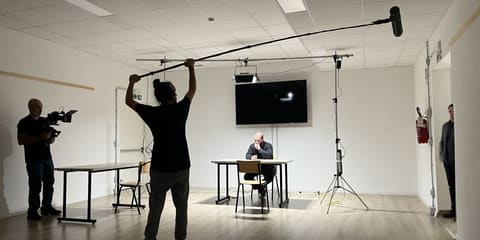
On a drama set the sound is decided in a few minutes: the ones the production grants the mixer before shooting. What follows comes from my experience as a location sound mixer, often working alone, and describes what I can do on set and what I need from the people organizing it. What can be recovered in post-production, and with which restoration tools, is a separate subject.
The short answer. The location sound mixer mikes the actors, holds the boom with the shotgun and records, alone or with a crew. They need time to mike (about 5 minutes per actor), a tail before cut, a moment of silence before Action is called and a crew that knows what to avoid. A few minutes of attention on set save hours of work afterwards.
The ideal set
The set where I work best is the one where every department respects the role of the others. In practice: there is time to put a microphone on every actor and, if needed, to place microphones in the rooms. There is an open dialogue with the director of photography, because the shotgun on the boom (the pole) has to stay where the camera does not see it and where it casts no shadows into the frame. To manage that I learn the actors' movements and the points where the camera moves, and for that I need a few extra minutes before the clapper, or a few extra takes.
The unpredictable set
A set is a living place, and when neither the crew nor the actors have experience with location sound, the same things keep happening. Knowing them in advance helps prevent them:
- the wireless transmitter is delicate, especially near the cable attachment and the antenna: sitting on it or pulling the cables damages it;
- an actor who is uncomfortable with the microphone may take it off, and simply saying so lets us fix it together;
- there is not always time for a sound test, and then the solution moves to post-production;
- improvised scenes, which were not planned and so not studied beforehand, have to be miked on the fly.
A short briefing at the start of the day solves almost everything: who is in the scene, where we are shooting, where the microphone goes.
Alone or in a crew
I often work alone: I record, hold the boom with the shotgun and listen in headphones to a mix of lavaliers and shotgun. What I cannot do is manage a live mix for the camera or fix a preamp problem while rolling. I can mike well with the shotgun and record everything properly, with experience, by feel and by trial.
With a crew things change: a mixer sits at the desk with recorders and receivers, solves level and reception problems live and mixes the feed for the camera and the director, while the boom operator looks after the boom only and hears in the headphones what the shotgun hears.
Shotgun and lavalier
In post-production the main timbre almost always comes from the shotgun on the boom. Lavaliers, the microphones worn on the body, are there for proximity and are synchronized in phase with the shotgun.
A lavalier performs best in the centre of the chest, 15-30 cm from the mouth, or hidden in the hair or under a cap. Too close to the neck and you hear the throat vibrations in the low mids, too far and the body of the voice is lost. Even though the capsules are omnidirectional, a lavalier shifted to one side of the body loses level and some frequencies when the actor speaks toward the opposite side. Clothes that rub against the capsule or cover it muffle the sound: the tricks for mounting it well deserve a guide of their own.
The shotgun has its own typical problem, the change of timbre when the microphone ends up off axis or changes distance within the same sentence, and a shotgun that is too far from the source is a problem too. In post it is reduced by blending the shotgun signal with the lavalier, in phase, to recover some timbre.
Room, noise and location scouting
With wide shots you cannot get close with the boom, and in a room that rings the lavalier alone is not enough. Ideally there would be time and budget for a scouting visit dedicated to sound, and a decision, together with photography and set design, on how to treat the location acoustically to get drier audio.
The relationship with the costume department matters too: the lavalier has to be hidden, not every garment lends itself, and with make-up things get complicated. That is why miking happens in parallel with dressing: as soon as an actor is ready at costumes, they come to the mixer. It takes about 5 minutes per actor, often a couple is enough, but sometimes I need to test how the microphone holds up when the actor moves, and sometimes the outfit has to be changed.
For constant noises such as a fridge, an air conditioner or a generator, the rule on set is to switch them off or move them as far away as possible. In post-production a constant background noise is today handled without much trouble, but the less there is on set, the better.
Small precautions for the whole crew
They cost a few seconds and are decided before shooting:
- once the action starts, the crew behind the camera stays silent, and only the director speaks to the actors;
- soft-soled shoes, and no synthetic fabrics that rustle or jewellery that jingles;
- doors, windows and objects stay where they are: moving them changes the sound of the room and creates continuity problems;
- the actors' phones in airplane mode, so they do not disturb the wireless microphones;
- the camera microphone always on, even in rehearsals and service shots: it serves as a synchronization reference.
Four requests to the production
- Give the time to mike every scene and every actor properly.
- Leave a tail before cut. If there is traffic behind, waiting for it to calm down, or for a few seconds to pass, allows a long, soft fade in post that hides the edits.
- Leave a moment of silence before saying Action, after the clapper, so that the reverb tail of the room decays and the start of the scene stays clean.
- Organize breaks and hot meals well. A rested crew stays quiet and listens to instructions (and this, I admit, is also a joke).
I add one precaution to agree on before shooting. Whoever is off camera should not repeat the lines to the actor in frame, at least not in the takes dedicated to close-ups with dialogue, because every shot gets polluted by audio that cannot be seen and in the edit it becomes hard to move from one take to another without reverb tails and overlaps.
Room tone in practice
Room tone is the silence of a room, recorded to cover gaps in the edit. In theory you record 30-40 seconds of absolute silence for each room. In practice the one recorded separately can rarely be used, even if it is in the same room: the exact silence that exists during a take exists only at that moment. Problems on the shotgun takes are usually patched with bits of silence from the same take or from neighbouring ones, shot the same day in the same room. That is why the seconds of silence before and after each action count more than a dedicated recording at the end of the day, when it is rarely possible to ask everyone to be quiet.
The sound report
For whoever does the audio post-production and for whoever edits, it is essential to receive a sound report with what is needed to find their way. It works if the production keeps track of scene names and if whoever slates reads the right information, accurately.
To sum up
A few minutes of attention on set save hours of work afterwards. You do not need a crew of specialists: you need a mixer who is given the time to do the job and a set where everyone knows what to avoid. If you are preparing a production and want to talk about it before shooting, write to me.
Written by AI based on Riccardo’s experience, then reviewed and approved by him.